
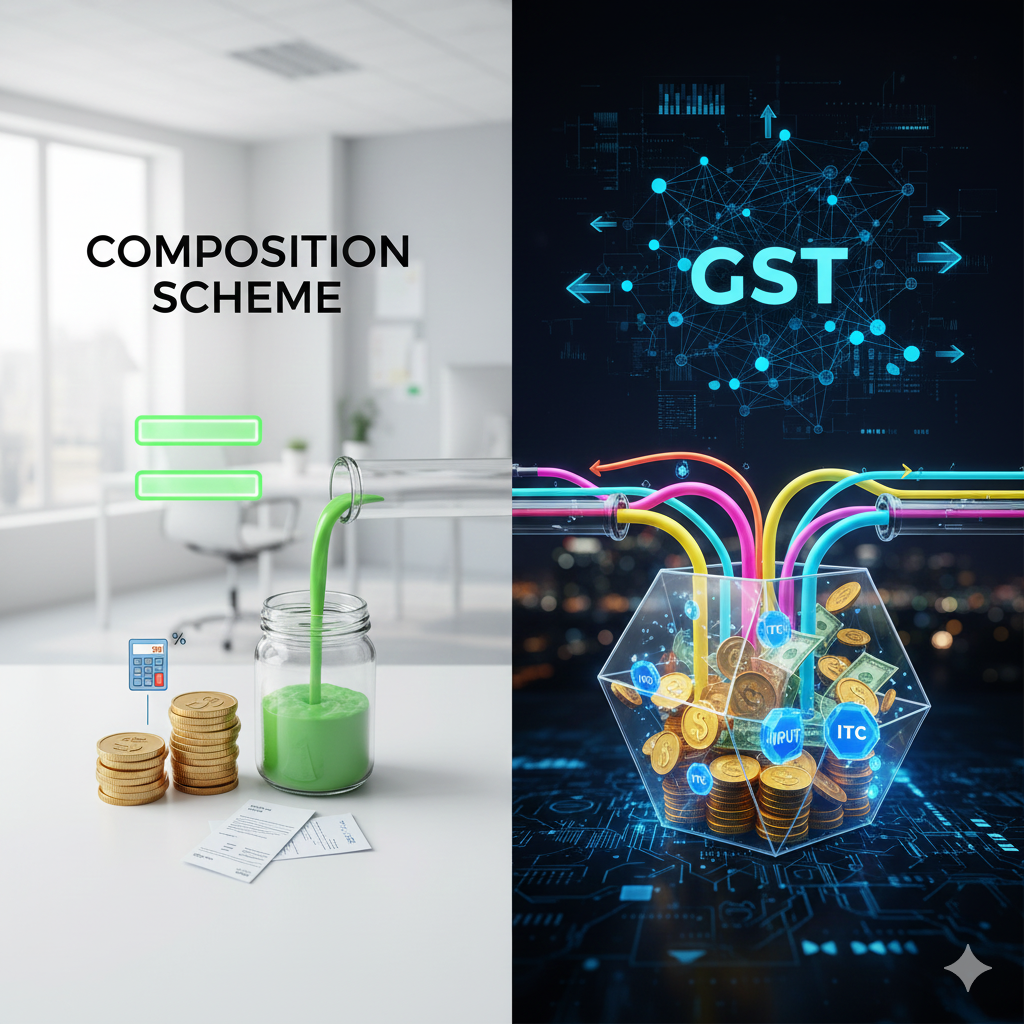
What is GST (Goods and Services Tax)?
GST is a single indirect tax introduced in India on 1 July 2017. It replaced multiple indirect taxes like VAT, Service Tax, Excise Duty, etc. GST is levied on the supply of goods and services and is collected at each stage of value addition.
Types of GST:
- CGST – Central GST (collected by Central Government)
- SGST – State GST (collected by State Government)
- IGST – Integrated GST (on inter-state supply)
Benefits of GST:
- One nation, one tax
- Reduces tax burden
- Transparent tax system
- Input Tax Credit (ITC) available
- Boosts ease of doing business
What is the Composition Scheme under GST?
The Composition Scheme is a simplified GST scheme for small taxpayers to reduce compliance burden.
Who can opt for Composition Scheme?
- Businesses with annual turnover up to ₹1.5 crore
- For special category states, limit is ₹75 lakh
Tax Rates under Composition Scheme:
- Manufacturers & Traders: 1% (0.5% CGST + 0.5% SGST)
- Restaurants (no alcohol): 5%
- Service providers (special scheme): 6%
Key Features:
- Pay GST at a fixed lower rate
- Quarterly return instead of monthly
- Less paperwork
- No need to maintain detailed records
Limitations:
- Cannot collect GST from customers
- Cannot claim Input Tax Credit (ITC)
- Cannot do inter-state supply
- Not suitable for e-commerce sellers
Difference between Normal GST & Composition Scheme
| Basis | Normal GST | Composition Scheme |
|---|---|---|
| Tax Rate | As per GST slabs | Fixed lower rate |
| ITC | Allowed | Not allowed |
| Returns | Monthly | Quarterly |
| Compliance | High | Low |
| Inter-state supply | Allowed | Not allowed |
If you want this in 100 words, Hindi version, exam-ready notes, or a comparison chart, tell me 😊
Composition Scheme And GST
Here is a clear and exam-ready explanation of Composition Scheme and GST (India):
GST (Goods and Services Tax)
GST is an indirect tax implemented in India from 1 July 2017. It is levied on the supply of goods and services and has replaced many indirect taxes like VAT, Service Tax and Excise Duty. GST is a destination-based tax and helps create a unified national market.
Types of GST:
- CGST – Central Goods and Services Tax
- SGST – State Goods and Services Tax
- IGST – Integrated Goods and Services Tax
Composition Scheme under GST
The Composition Scheme is a simplified GST scheme designed for small taxpayers to reduce compliance and tax burden.
Eligibility:
- Annual turnover up to ₹1.5 crore (₹75 lakh for special category states)
Tax Rates:
- Manufacturers/Traders – 1%
- Restaurants (no alcohol) – 5%
- Service providers – 6%
Features:
- Lower tax rate
- Quarterly returns
- Minimal record-keeping
Restrictions:
- No Input Tax Credit (ITC)
- Cannot collect GST from customers
- No inter-state sales
In short, GST simplifies taxation, while the Composition Scheme helps small businesses comply easily with GST laws.
If you want this in Hindi, 100 words, or with a comparison table, let me know.
No responses yet